
What Is Kinetic Humanism?
Kinetic Humanism is a systems based way of understanding how people, routines, and structures hold themselves together through small acts of repair. It focuses on the movement of coherence through a system and how that movement strengthens or weakens the shape of the whole. Rather than treating behaviour as fixed, it looks at how systems shift over time and how early signals show where change is already taking place.
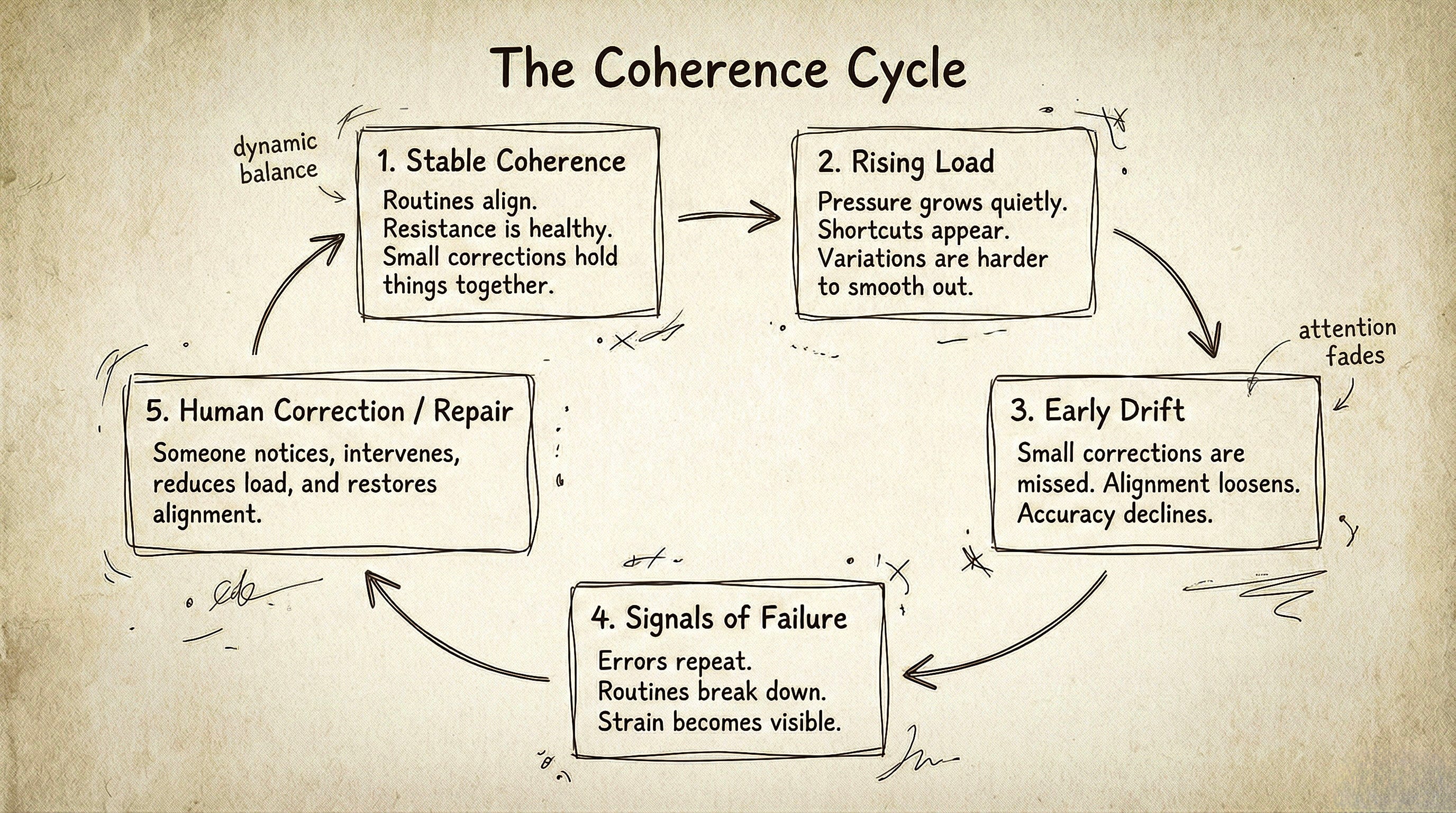
At its centre is a simple idea. Every system has a usual way of staying aligned. When that alignment begins to loosen, small adjustments appear long before anything breaks. Kinetic Humanism pays attention to these changes. It studies load, drift, resistance, early failure signals, and the human capacities that restore shape. It treats attention, stewardship, and early action as the practical forces that improve coherence.
The framework grew out of work on the charity shop floor, where routines change quietly and the smallest action can prevent tomorrow’s problems. It brings together ideas from organisational safety, cognitive systems, and human behaviour, but keeps its focus on lived experience rather than theory. The aim is to understand how things fall out of alignment and how people bring them back.
Kinetic Humanism is still developing. Each applied piece explores a different part of the model, from the way load accumulates to the way early signals appear before surface failure. The concept is intended to be practical and usable rather than abstract. It is a way of seeing systems through their behaviour and through the humans who keep them moving.
Kinetic Humanism is developed by Rowan Broadley as a practical framework for understanding system behaviour and human repair.